Platform overview
Vestis Labs is designed to centralise and streamline your product development workflows by bringing styles, materials, costings, suppliers, and collaboration into one connected platform.
Under review. This page is published while we check it against the live app, so some details may have changed.
Screenshots may be out of date.
Introduction & best practice
Vestis Labs is designed to centralise and streamline your product development workflows by bringing styles, materials, costings, suppliers, and collaboration into one connected platform. By using Vestis Labs, teams can reduce manual work, improve accuracy, and ensure a single source of truth from initial concept to production handover.
Home is the landing page after you sign in. It is designed to get you into your work quickly, whether that means starting something new or checking on what's already in progress.
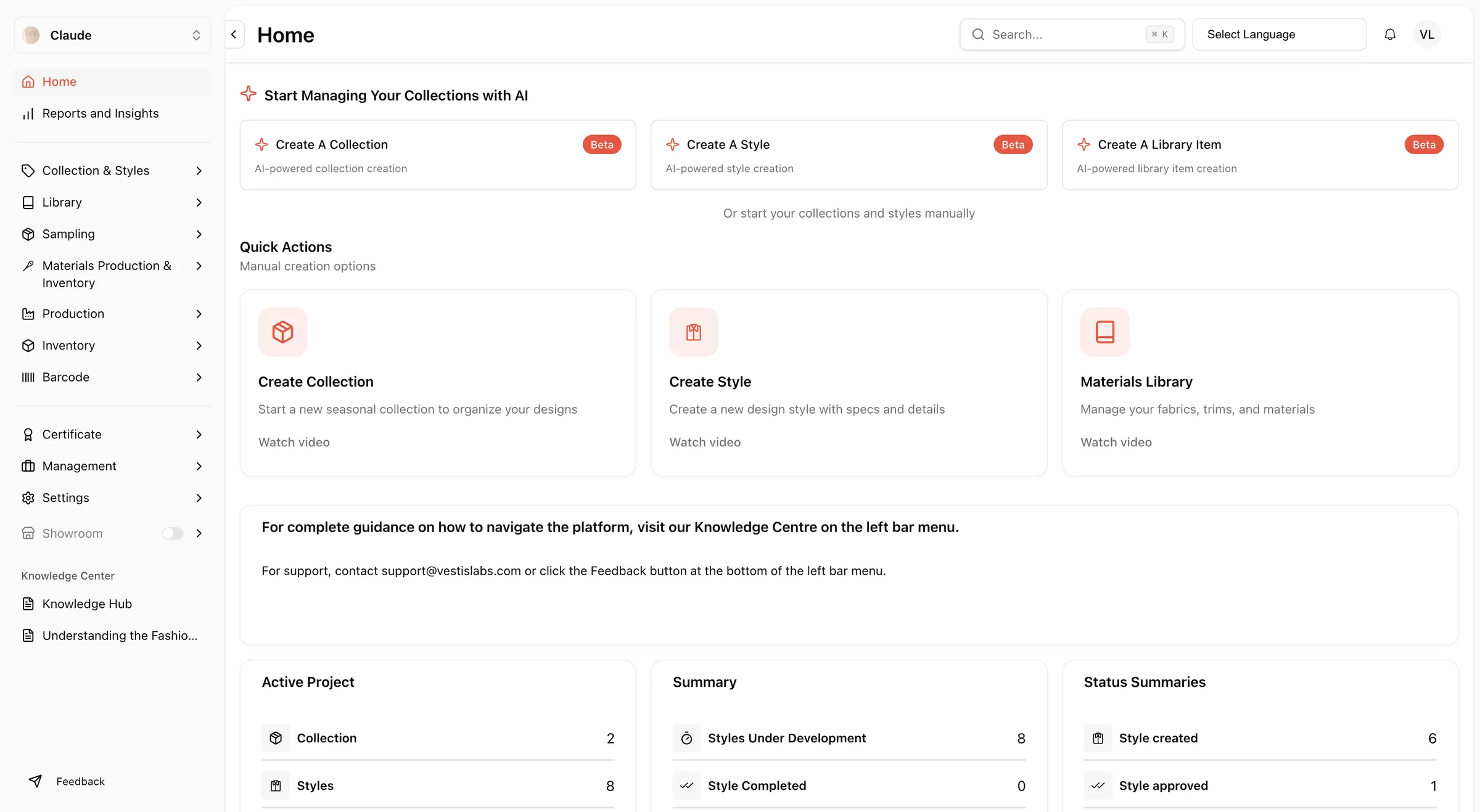
Every page in Vestis Labs shares the same top navigation bar. It gives you fast access to search, language preferences, notifications and your account, no matter which module you are currently working in.
Select Language
Changes the display language of the platform interface.

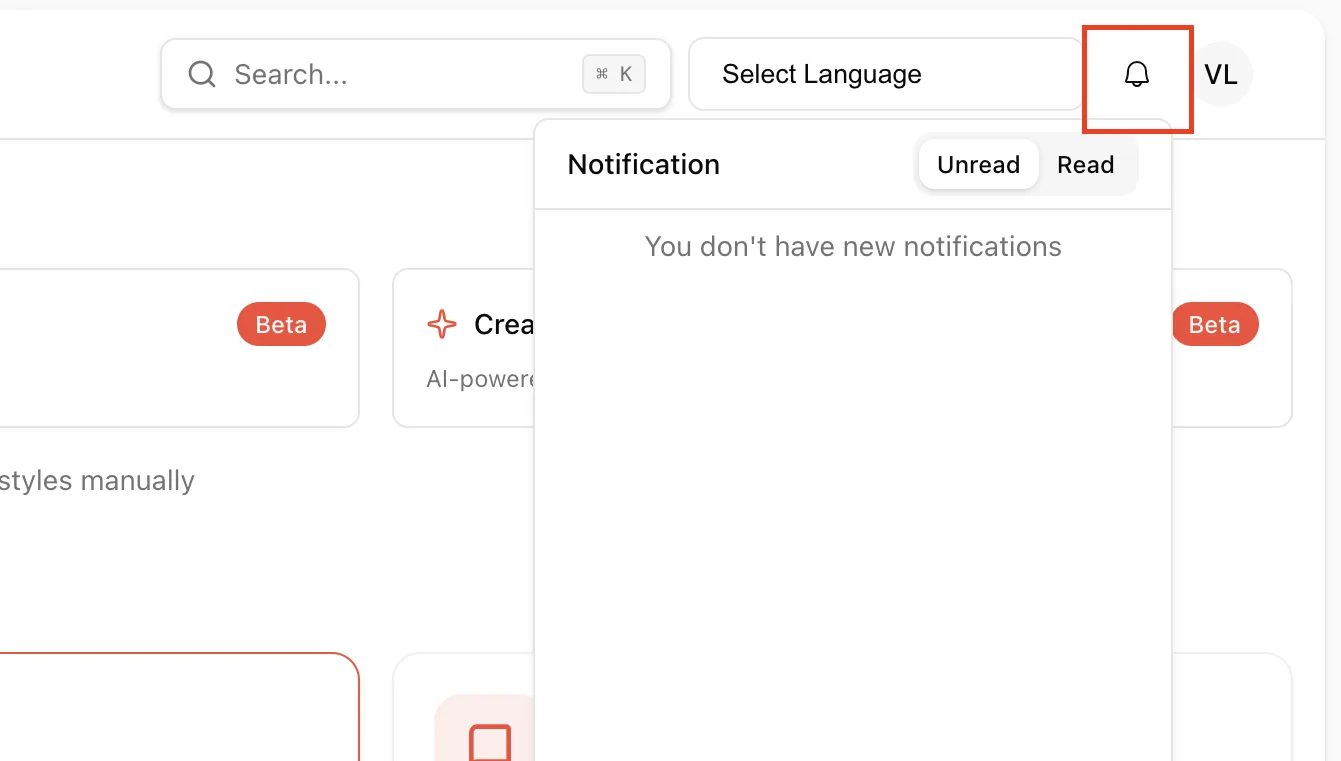
Notifications (bell icon)
Opens your notification center, showing alerts such as style status changes, approvals awaiting your review, or comments from teammates.
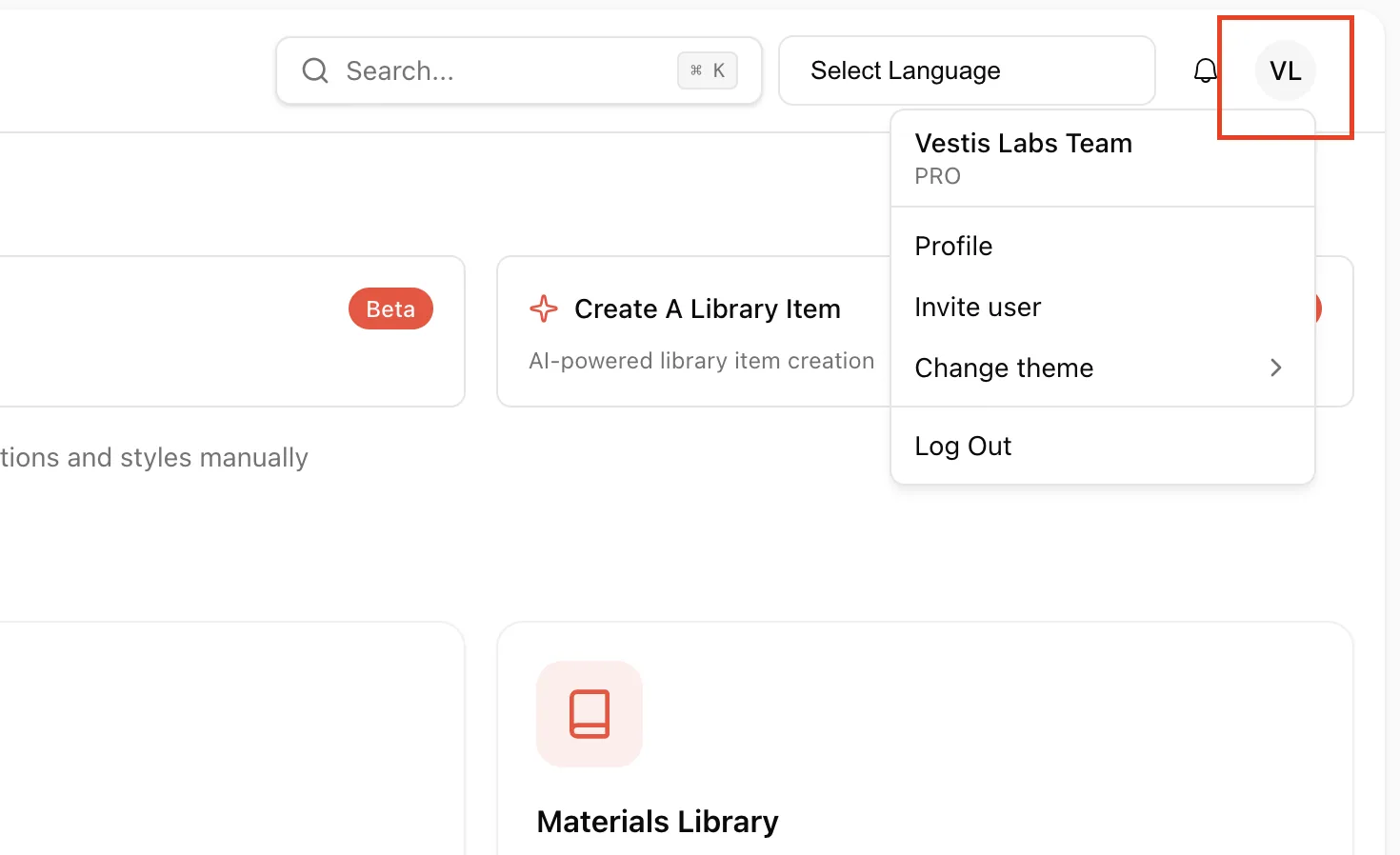
Account profile
Shows your initials or photo. Opens quick access to your profile and account options; full profile settings live under Settings → User Profile.
Search
Opens the global Search bar (shortcut: ⌘K / Ctrl+K). Use it to jump straight to any page or action, or to start a search for a Style, Collection or Material, without navigating the sidebar. See Use the command palette.
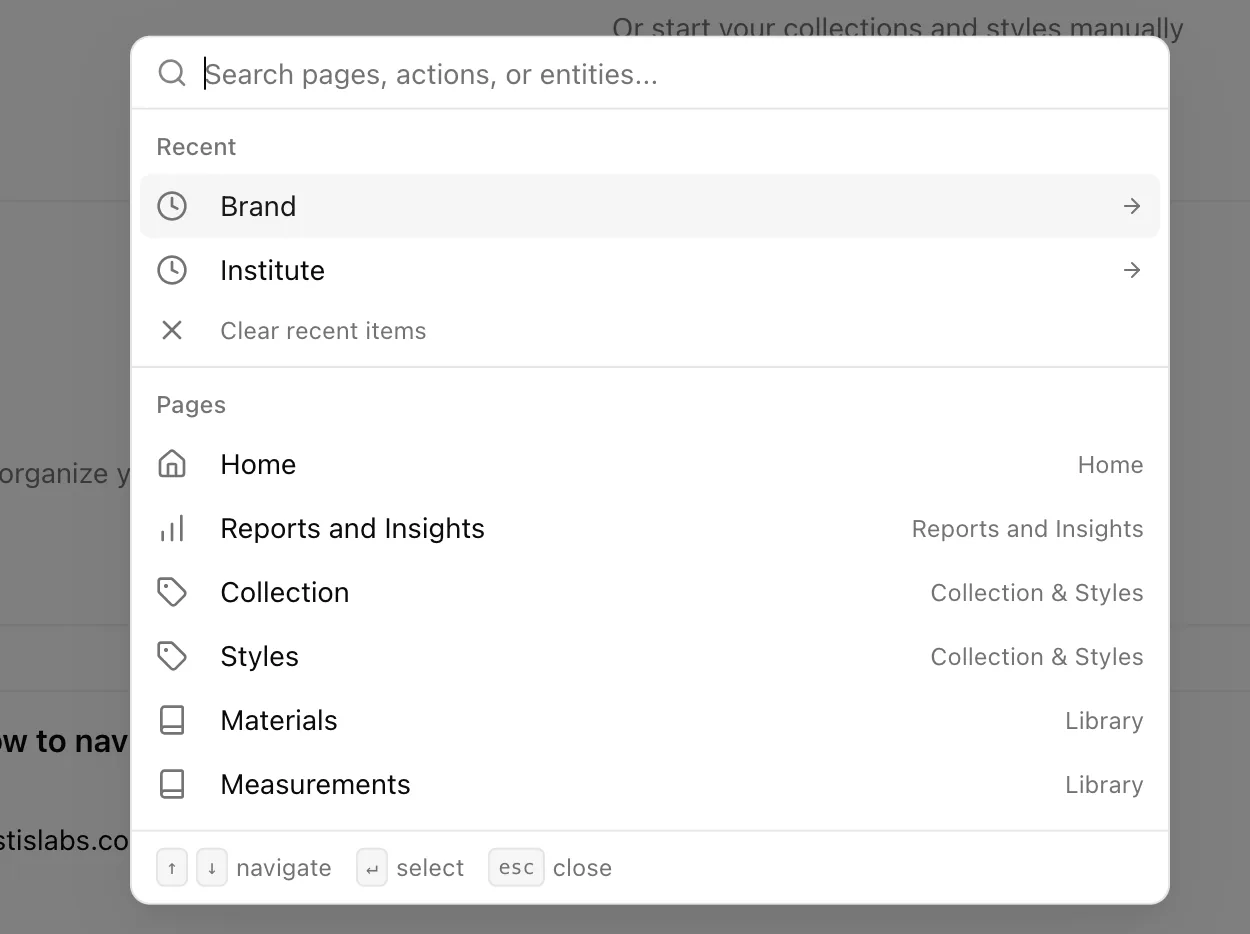
- Type to search — results update instantly across pages, actions and search shortcuts for Styles, Collections and Materials.
- Recent — the top of the panel shows pages you opened from here recently, so you can jump straight back to them. "Clear recent items" resets this list.
- Pages — a directory of the platform's main sections (Home, Reports and Insights, Collection & Styles, Library and more) that you can jump to even before typing anything.
- Keyboard navigation — use the ↑ / ↓ arrow keys to move through results, ↵ Enter to open the highlighted item, and Esc to close the palette.
Start managing your collections with AI (beta)
A row of AI-powered shortcuts sits at the top of Home. These use AI to generate a starting point for you, which you can then review and refine manually.

Create A Collection (Beta)
Uses AI to generate a new seasonal collection for you based on prompts you provide, rather than building it field-by-field.
Create A Style (Beta)
Uses AI to generate a starting style record — specs, details and structure — that you can then edit.
Create A Library Item (Beta)
Uses AI to generate a new Library entry (for example, a material or measurement set).
Quick actions
Quick Actions are the manual, non-AI equivalents of the shortcuts above — the standard way to create core records. Each card links to a short "Watch video" walkthrough.
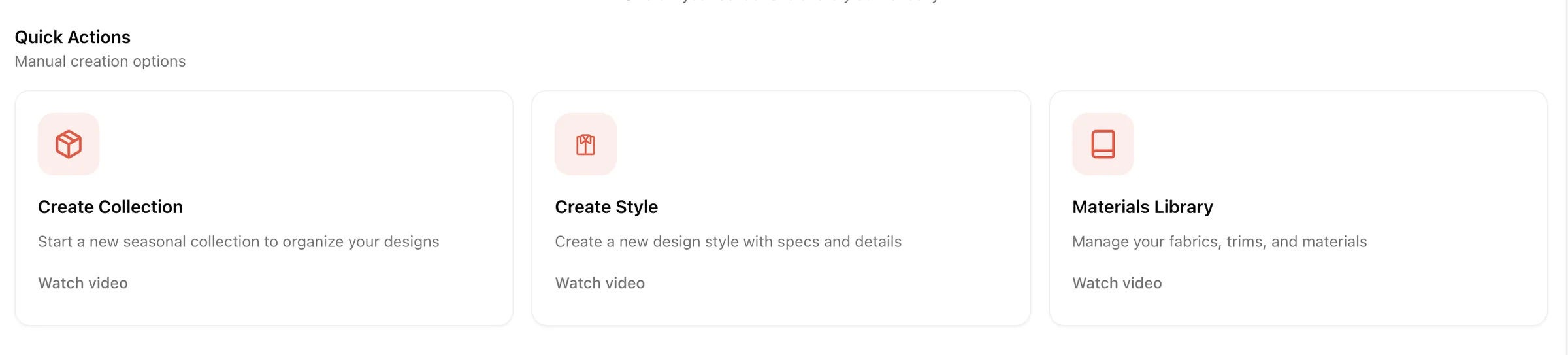
Create Collection
Starts a new seasonal collection so you can group and organize your styles by season, drop or theme.
Create Style
Creates a new design style record, where you build out specs, construction details and imagery.
Materials Library
Opens the materials library, where you manage the fabrics, trims and other materials used across your styles.
Active project, summary & status summaries
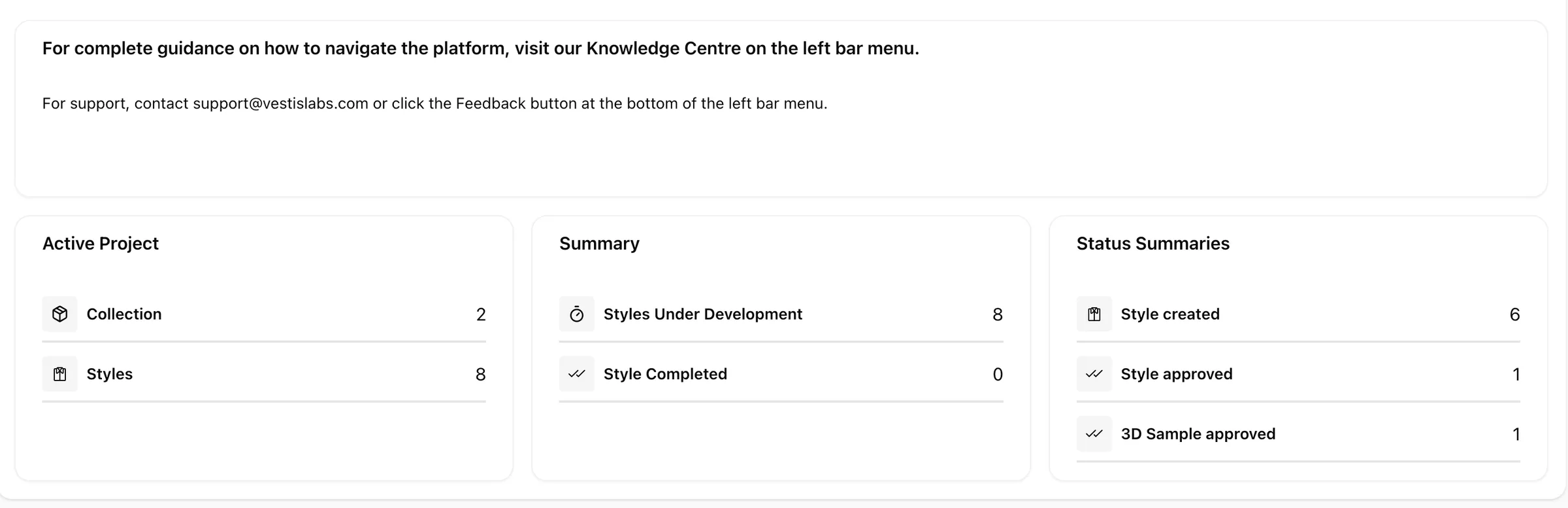
Below the creation options, three panels give you an at-a-glance status of your current work.
Active Project
Shows the live counts of Collections and Styles you currently have in progress.
Summary
Tracks how many styles are Under Development versus Completed, giving a quick read on overall progress.
Status Summaries
Breaks down styles by lifecycle milestone reached — for example how many have been Created, Approved, or had a 3D Sample Approved.
Navigation sidebar — overview
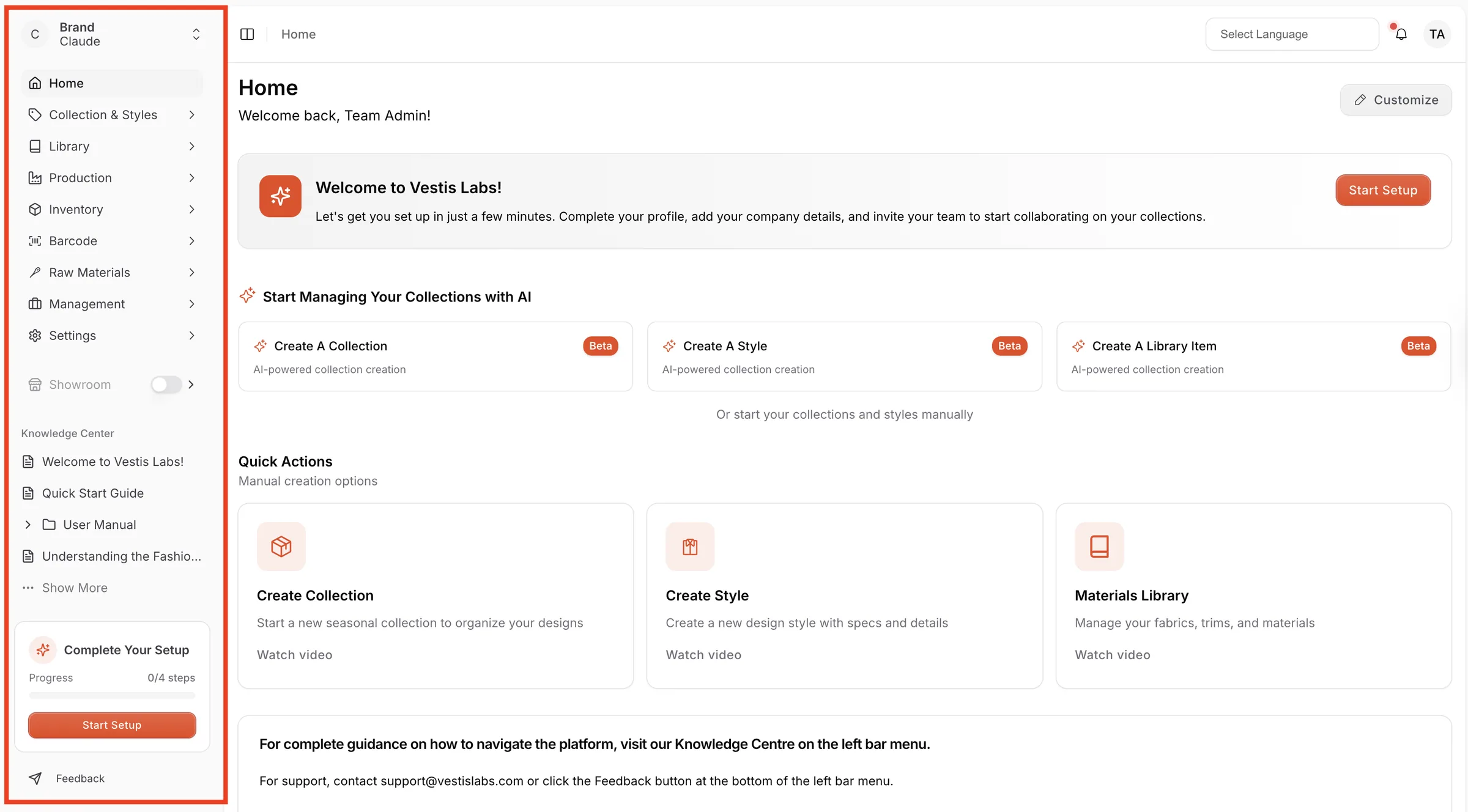
The left-hand sidebar is your main way of moving between modules. It is organized into two groups: day-to-day working modules at the top, and administrative Management / Settings sections toward the bottom, followed by Showroom, the Knowledge Center and Feedback.
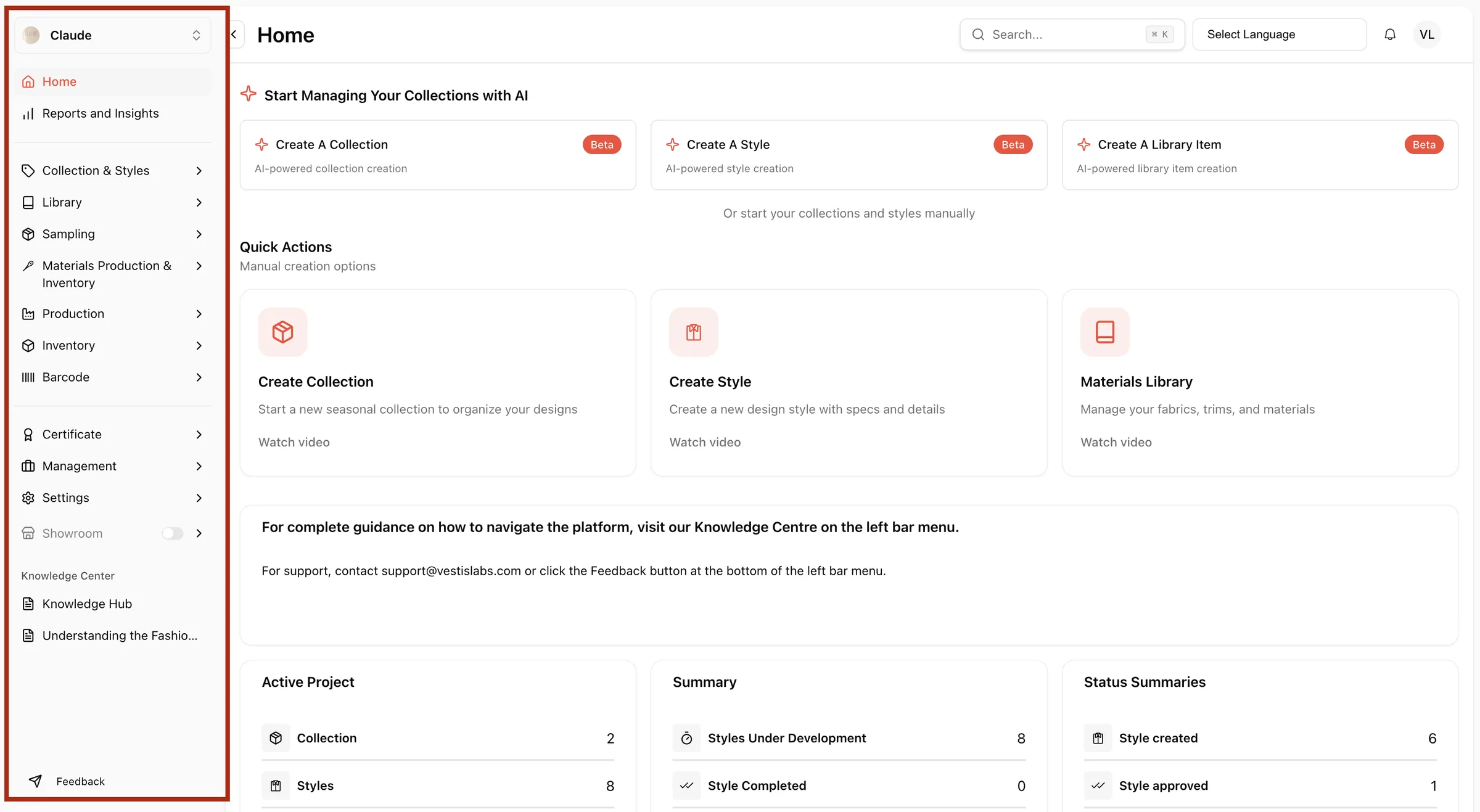
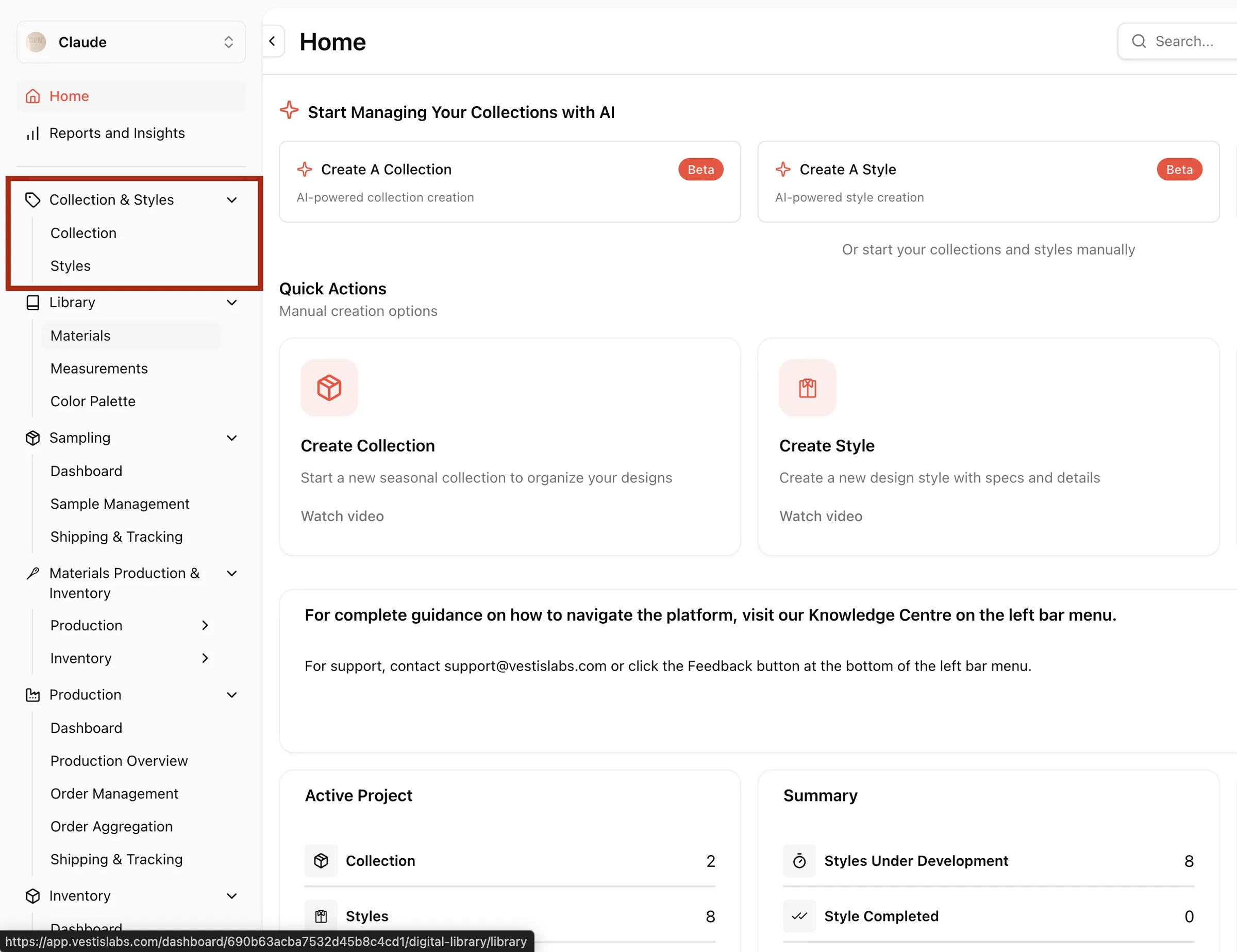
Collection & styles
Collection
Create and manage seasonal or themed collections. A collection acts as a container that groups related styles together (e.g. "Spring/Summer" or a capsule drop).
Styles
Create and manage individual style records — the design, specifications, construction details, materials and imagery for a single garment.
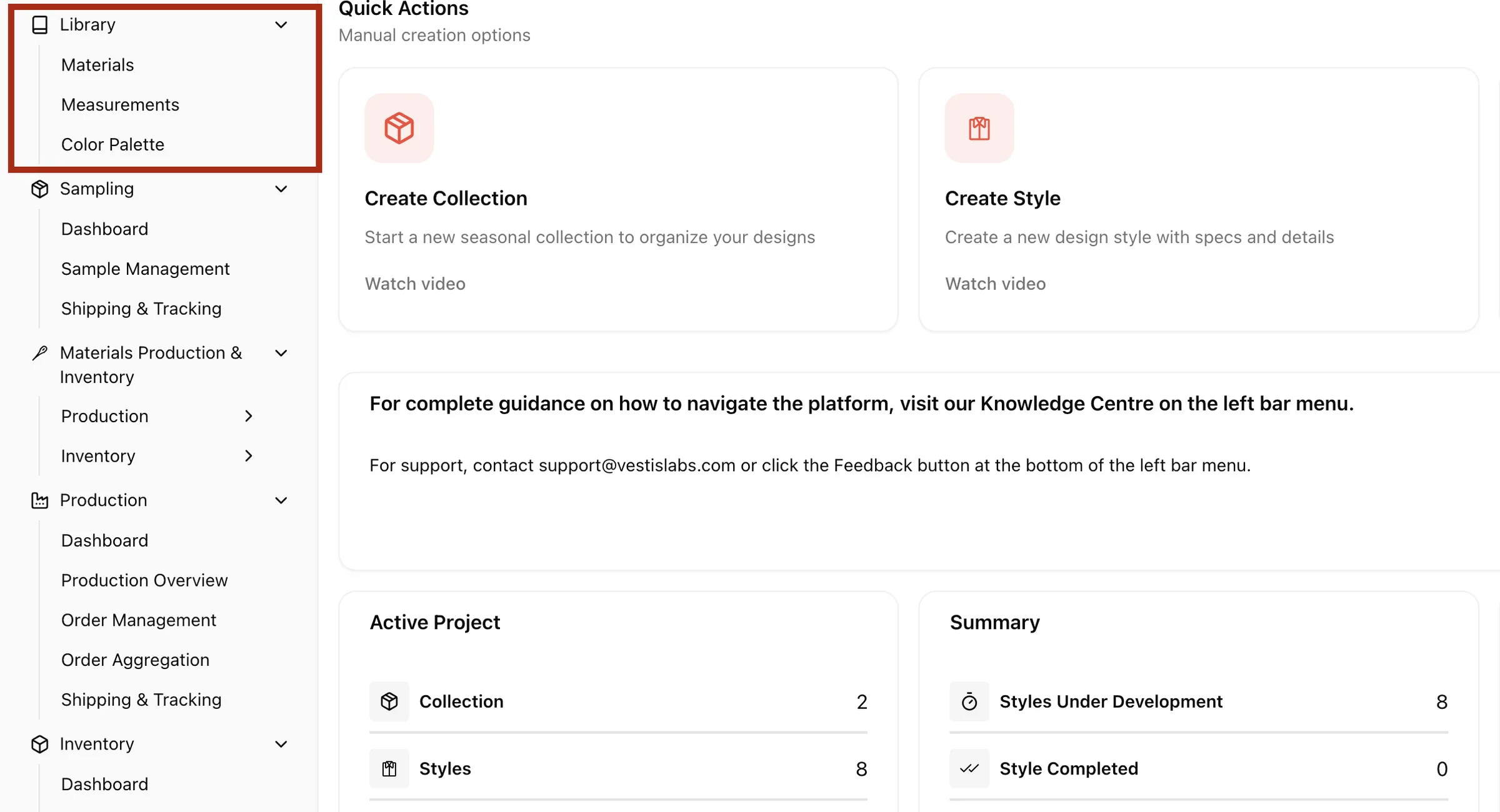
Library
Materials
Manage your catalog of fabrics, trims and other raw materials, including supplier details and specifications.
Measurements
Manage standard measurement charts and points of measure used when specifying garment sizing.
Color Palette
Manage your brand's approved color library for consistent reference across styles and materials.
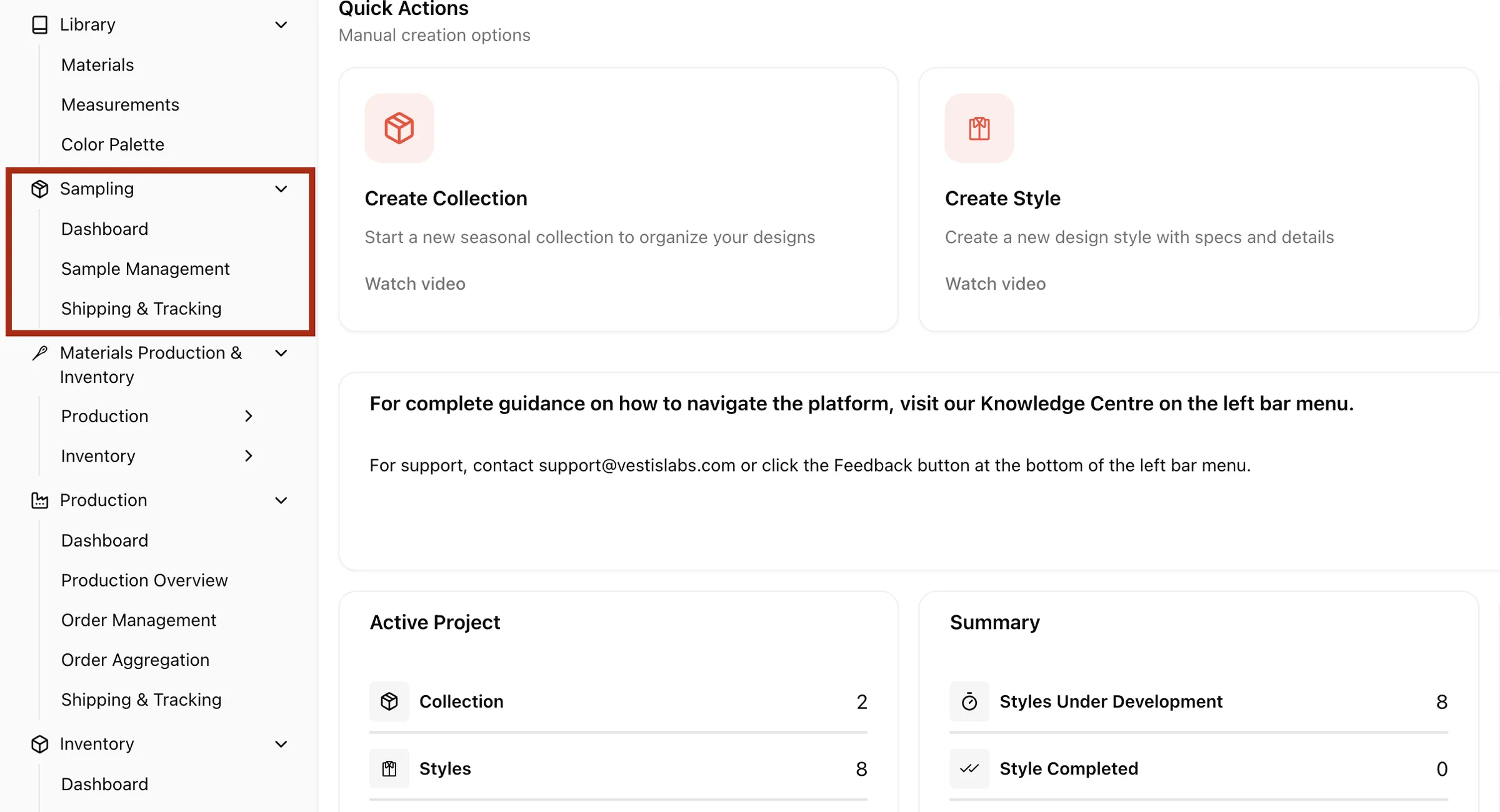
Sampling
Dashboard
An overview of sampling activity — what's in progress, what's overdue, and what's awaiting review.
Sample Management
Create, track and review individual sample requests and their approval status (e.g. proto, fit, or 3D samples).
Shipping & Tracking
Track the shipment of samples between locations, including carrier and delivery status.
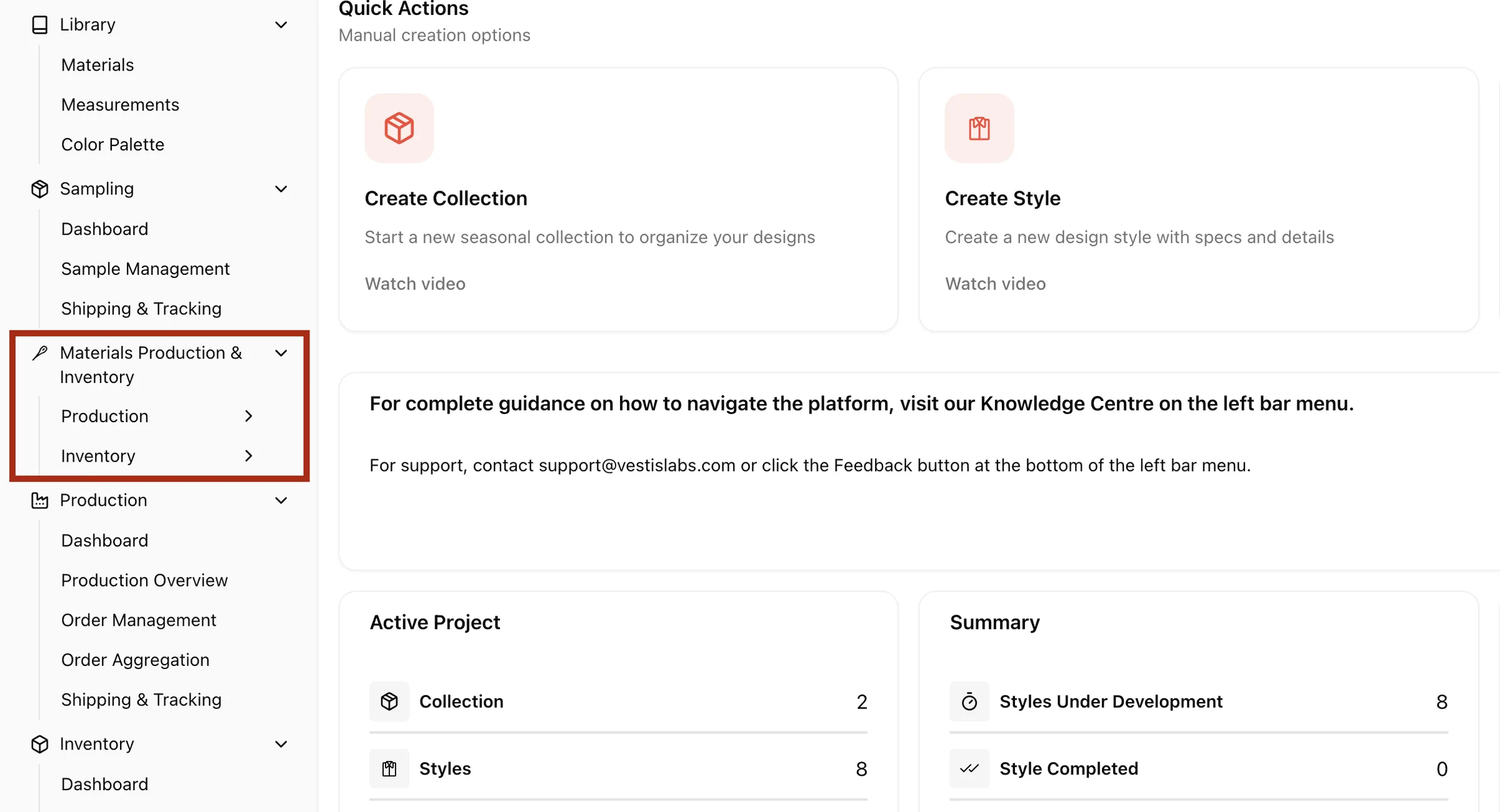
Materials production & inventory
Production
Manage production activity for raw materials — orders placed with mills or trim suppliers, and their progress.
Inventory
Track on-hand stock levels of raw materials such as fabric and trims.
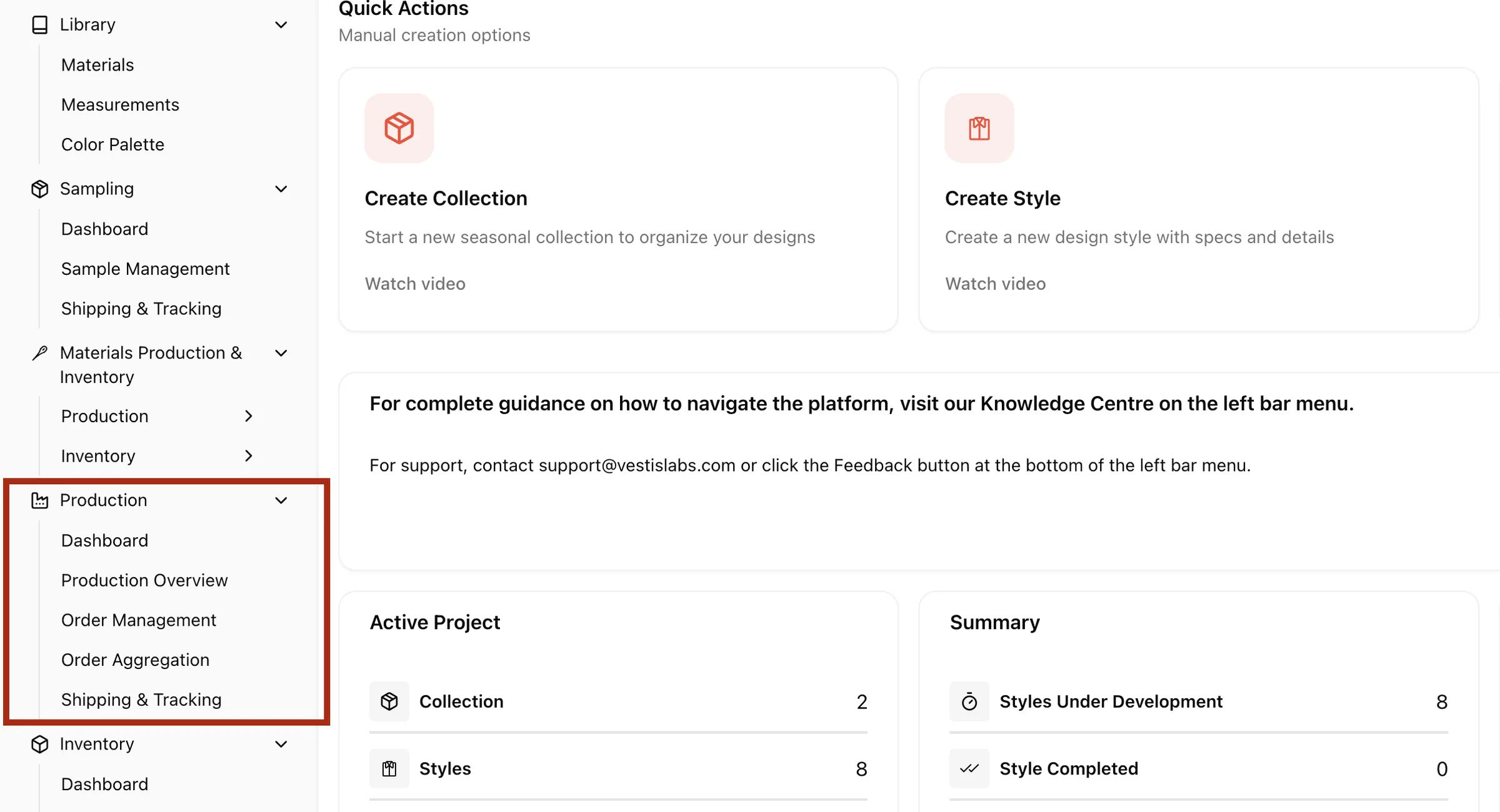
Production
Dashboard
A summary view of production activity across all active orders.
Production Overview
A broader, consolidated view of production status across styles, factories or timelines.
Order Management
Create, edit and track individual production orders, including quantities, factories and due dates.
Order Aggregation
Combine or group multiple orders together — useful for consolidating quantities across styles or customers before sending to a factory.
Shipping & Tracking
Track outbound shipments of finished production orders, including carrier and delivery status.
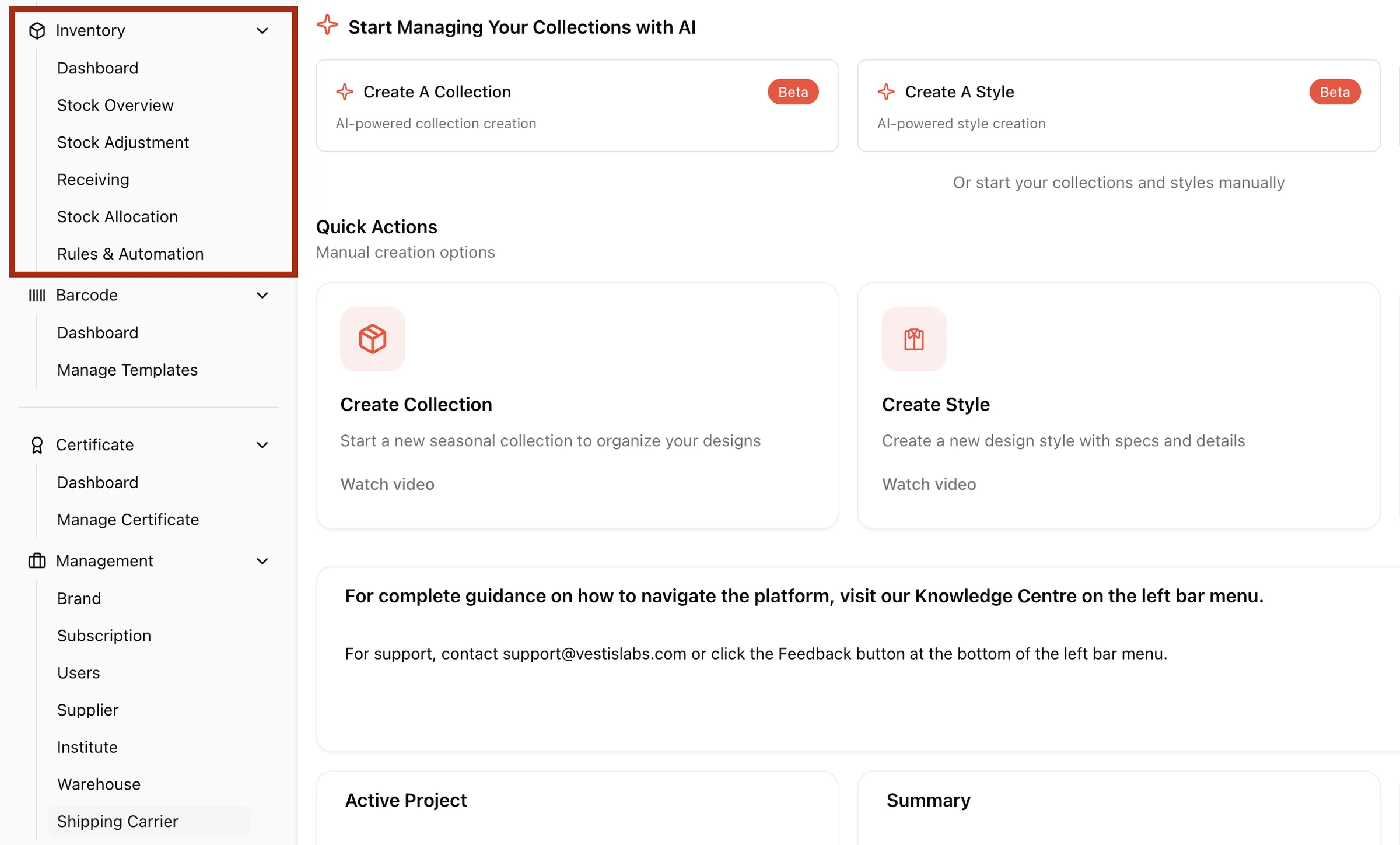
Inventory
Dashboard
An overview of current inventory levels and activity.
Stock Overview
A detailed, searchable view of stock on hand across warehouses, styles and SKUs.
Stock Adjustment
Manually adjust recorded stock quantities, for example after a stock count or to correct an error.
Receiving
Log incoming goods as they arrive at a warehouse, adding them to inventory.
Stock Allocation
Assign or reserve stock to specific orders, customers or channels.
Rules & Automation
Configure automated rules for inventory — for example automatic reorder points or allocation logic.
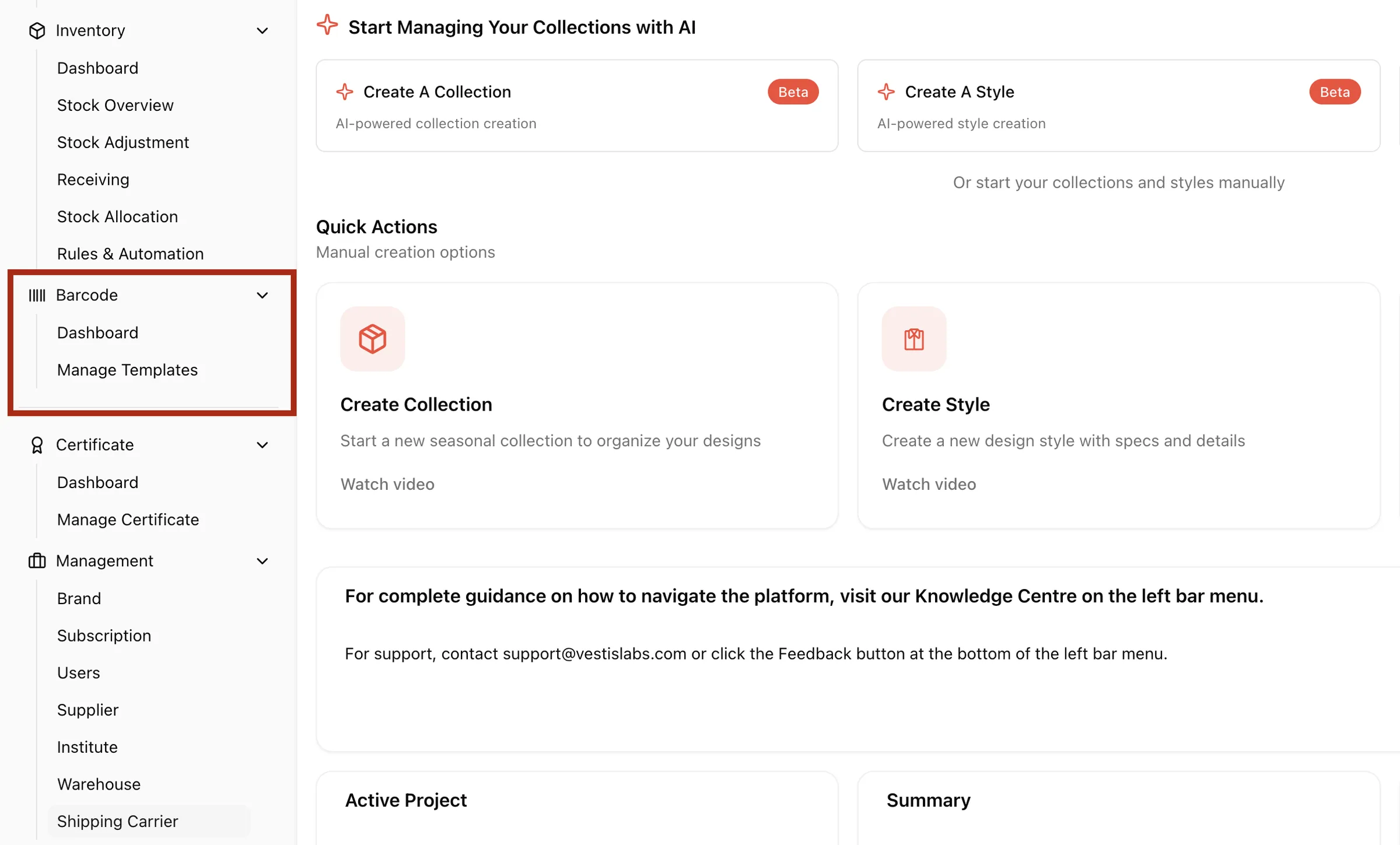
Barcode
Dashboard
An overview of barcode activity and usage.
Manage Templates
Create and edit the templates used to generate and print barcode labels.
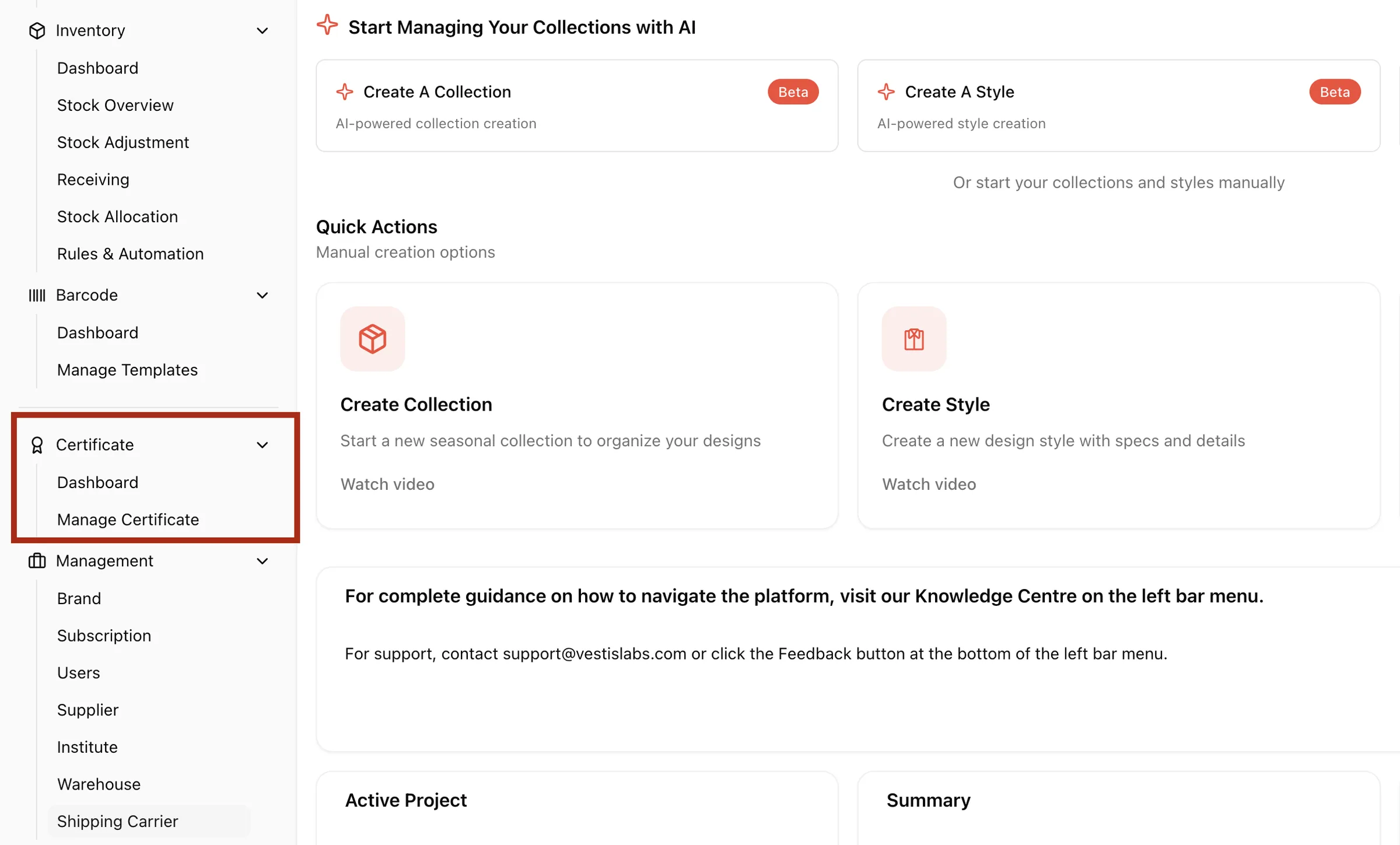
Certificate
Dashboard
An overview of certificates on file and their status (e.g. valid, expiring, expired).
Manage Certificate
Upload, edit and organize individual certificate records and link them to the relevant materials, styles or suppliers.
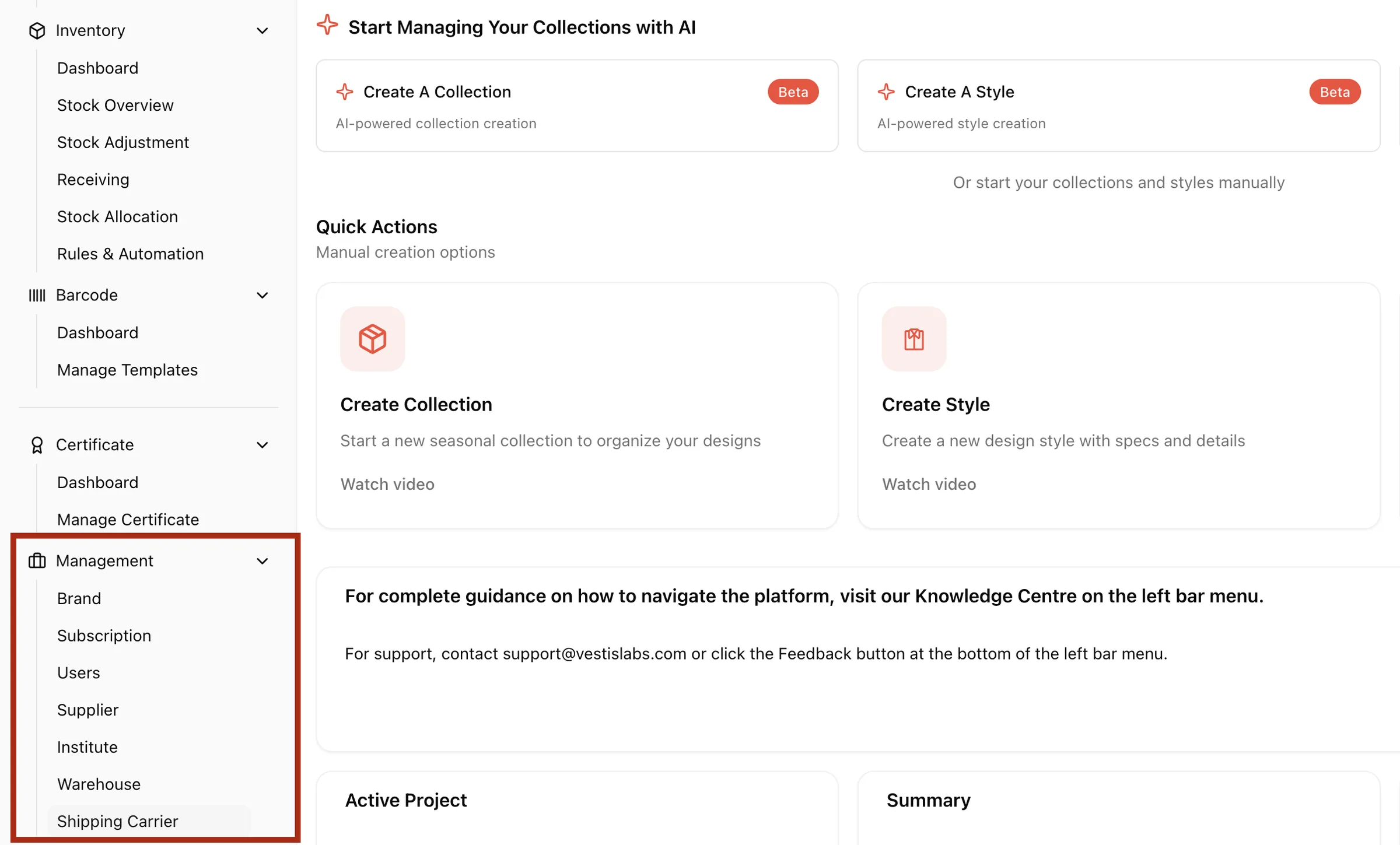
Management
Management contains the core administrative records that the rest of the platform relies on — your brand identity and the outside parties you work with.
Brand
Manage your brand profile — name, identity and brand-level settings used throughout the platform.
Subscription
View and manage your organization's subscription plan and billing.
Users
Add, remove and manage user accounts and their access to the platform.
Supplier
Manage records for the external suppliers you work with, such as mills, factories and trim vendors.
Institute
Manage records for affiliated institutes or organizations connected to your workspace.
Warehouse
Manage the warehouse locations used for receiving, storing and shipping inventory.
Shipping Carrier
Manage the shipping carriers available for use in Production and Sampling shipment tracking.
Settings
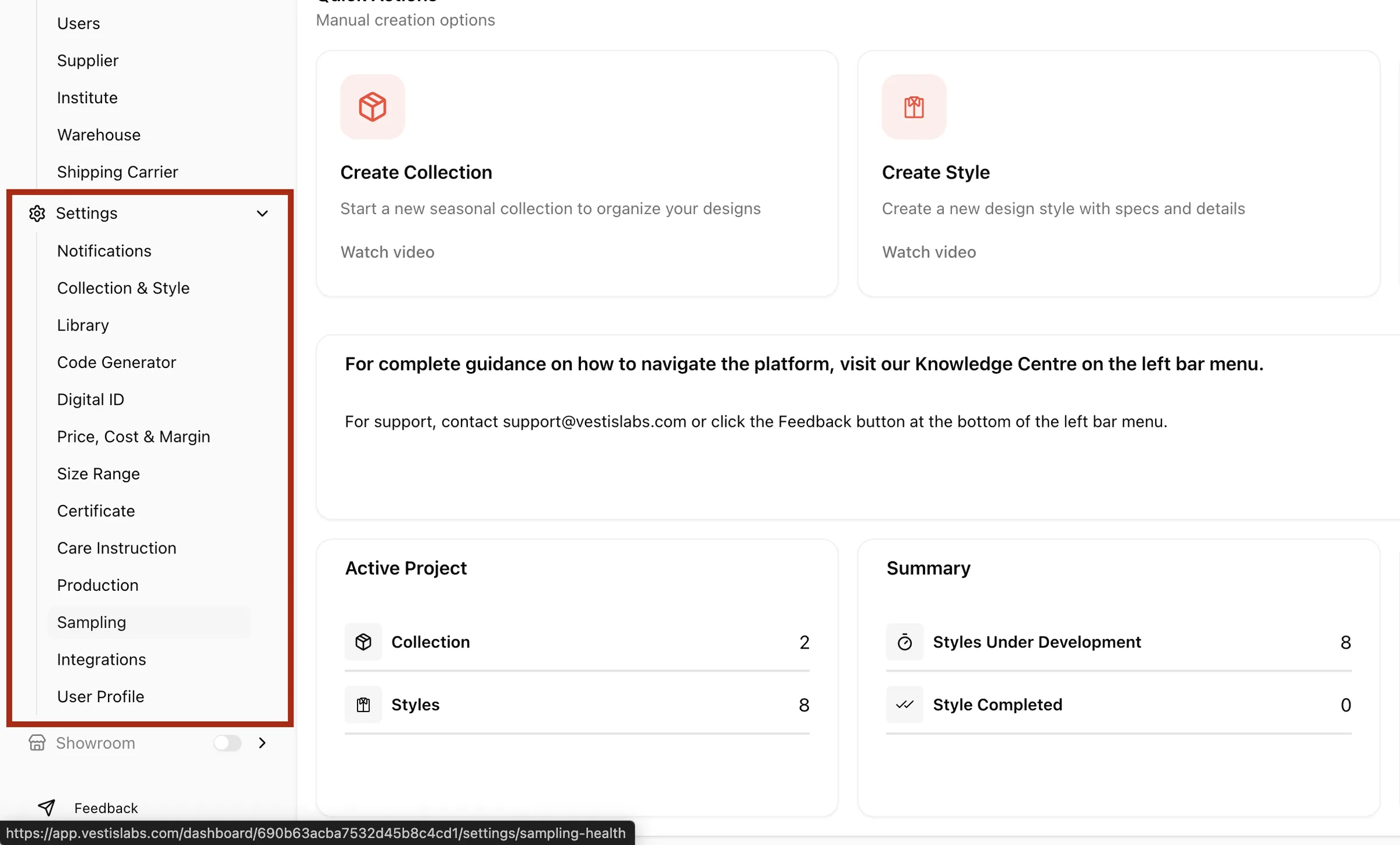
Settings is where you configure how the platform behaves — from notification preferences to the structure of your data.
Notifications
Configure which events trigger notifications and how you receive them.
Collection & Style
Configure default fields, statuses and options used when creating collections and styles.
Library
Configure default fields and categories used in the Library module (Materials, Measurements, Color Palette).
Code Generator
Configure automatic code or numbering formats used to identify styles, materials or orders.
Digital ID
Configure digital identifiers (e.g. for traceability or product passports) attached to styles or materials.
Price, Cost & Margin
Configure pricing, costing and margin calculation settings used across styles and orders.
Size Range
Configure the size ranges and size sets available when specifying styles.
Certificate
Configure certificate types and requirements used in the Certificate module.
Care Instruction
Manage the library of standard care instructions available to attach to styles.
Production
Configure default settings and workflow options for the Production module.
Sampling
Configure default settings and workflow options for the Sampling module.
Integrations
Connect and manage third-party integrations with the platform.
User Profile
Manage your own personal account details, such as name, photo and password.
Showroom
Showroom, found just below Settings in the sidebar, is a toggle-controlled feature (shown with an on/off switch) that presumably opens a customer- or buyer-facing presentation view of your collections and styles. Turn it on to enable Showroom and expand it (via the arrow) to access its pages.
Reports and insights
Found near the top of the sidebar, right below Home, Reports and Insights is your analytics hub. Use it to review performance and activity across collections, styles, production and inventory in report form, rather than record by record.
Knowledge center
The Knowledge Center sits toward the bottom of the sidebar and is your self-serve reference library for the platform itself.
Knowledge Hub
The main index of help articles and guidance for using the platform.
Feedback
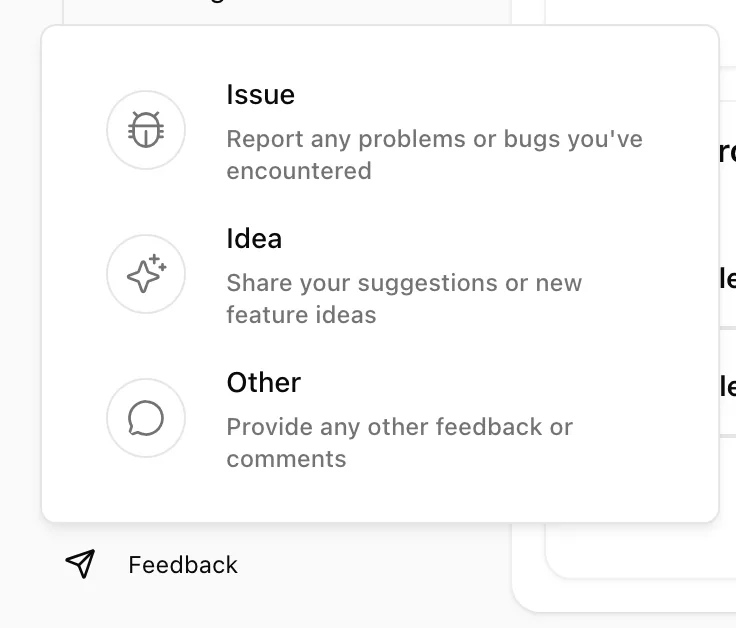
Issue
Report any problems or bugs you've encountered while using the platform.
Idea
Share suggestions or new feature ideas.
Other
Provide any other feedback or comments that don't fit the categories above.
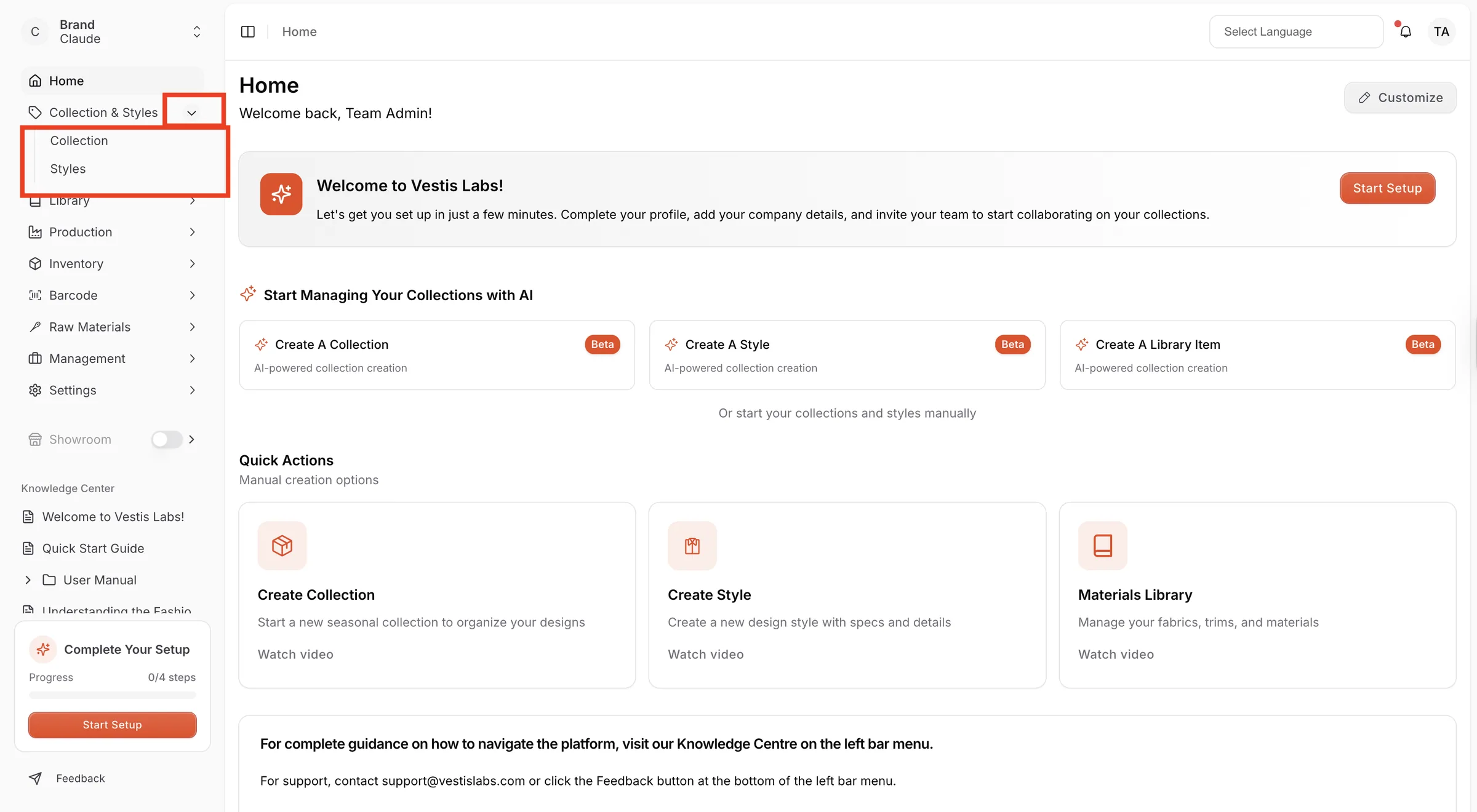
Users can expand or collapse the left bar menu. You can get a full page when the left bar menu is collapsed.
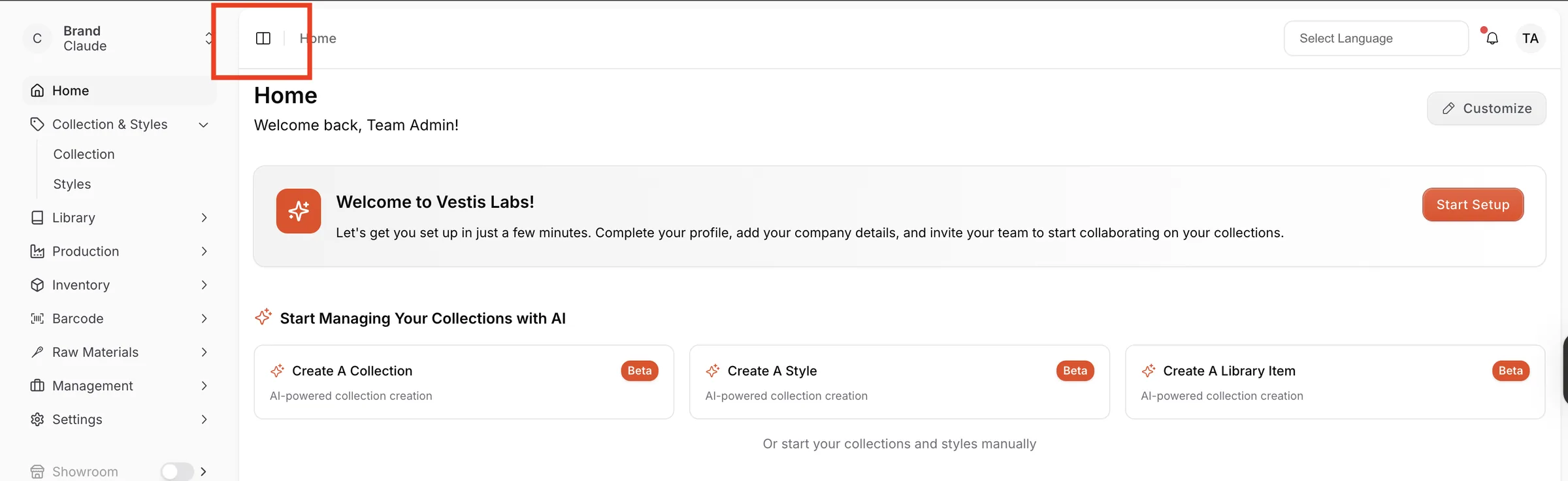
Dropdown: Users can use the dropdown icon to display or hide a navigation menu of options . Users can select multiple dropdown options.